
Kosovo: reception, detention and return on the edge of Europe’s border regime
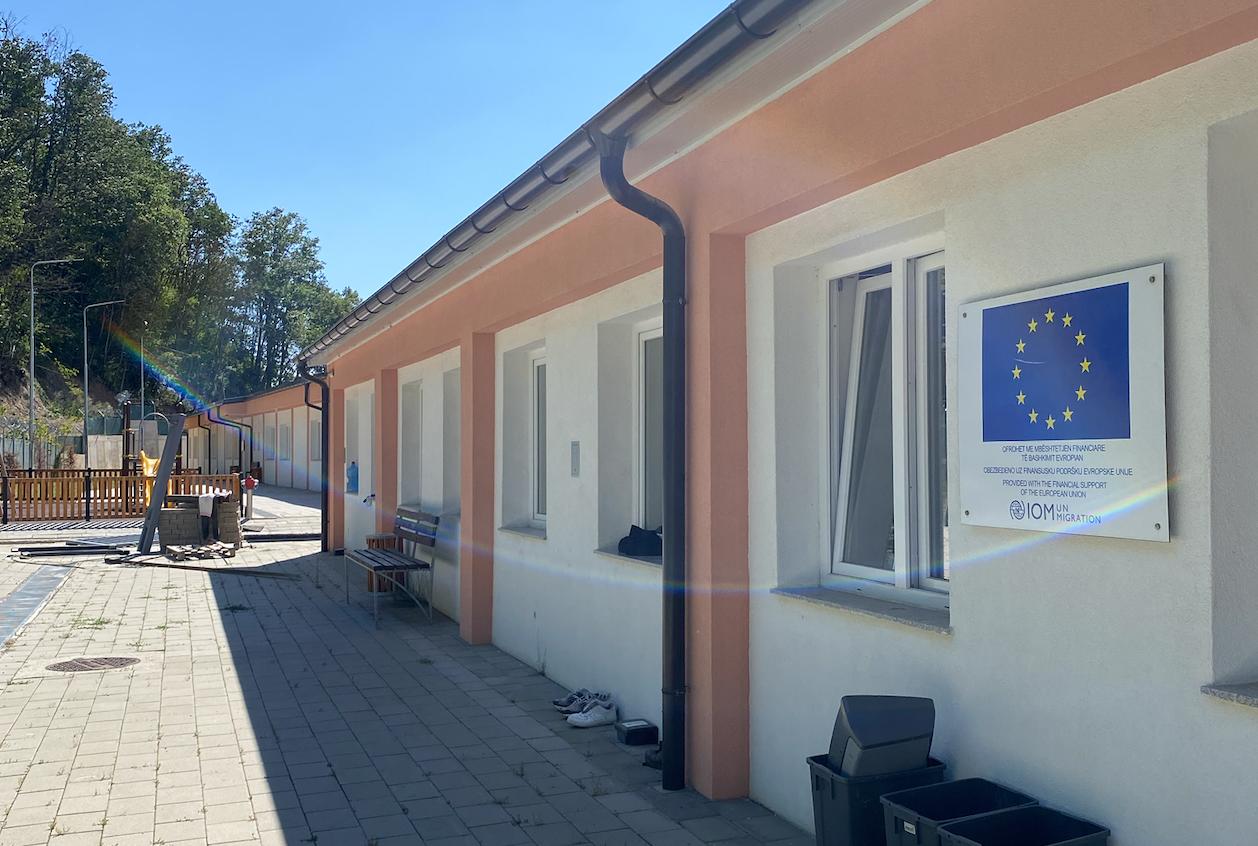
Vranidoll Temporary Reception Centre (TRC) outside area, picture taken by Collective Aid
*The article is based on a field assessment that was carried out by Collective Aid Bosnia and Serbia field teams between the 31 July-3 August 2026.
Key findings
Between 31 July and 3 August 2026, Collective Aid visited Kosovo to assess conditions for people on the move travelling through the country. The team travelled through Peja, Pristina and Mitrovica, met officials from the Department of Citizenship, Asylum and Migration (DCAM), the director of the Vranidoll Temporary Reception Centre (TRC), local and international organisations, journalists, residents and four people on the move. The assessment also drew on information gathered in Bosnia and Herzegovina, as part of Collective Aid’s field research, from people who had recently travelled through Kosovo.
The findings do not point to an immediate humanitarian emergency inside Kosovo’s formal reception system. The areas the team were shown in Vranidoll TRC ‘’s facilities were modern, clean, and well taken care of. Residents had access to food, water, hygiene items, laundry and some medical and legal. Several people described the centre positively. One Moroccan man, exhausted by his journey and previous experiences elsewhere on the route, repeatedly said that arriving in Vranidoll felt like “coming home”.
At the same time, the assessment also identified a system in which access to protection is time-limited, movement is monitored, detention can follow pushbacks, and returns may be labelled voluntary even where the alternatives are severely constrained. Kosovo is increasingly being positioned as a partner in the externalisation of migration control: a place where the consequences of other states’ border policies, deportation systems and detention practices may be shifted outward.
Route and population: what is visible and what is not
People interviewed by Collective Aid in Bosnia and Herzegovina have increasingly described travelling through Kosovo. During the assessment, the main entry route identified by officials and organisations was from North Macedonia, with some references to Albania and routes through the Prizren and Gjilan regions. The principal onward route appeared to be through Montenegro and then Bosnia and Herzegovina. Serbia seems to be generally avoided by the people we spoke to because of information about police interception, violence and onward transfer towards Bulgaria, though a local shopkeeper in Mitrovica said she sees people on the move every now and then, though it’s possible that from Mitrovica, despite being close to the Serbian border, people are still travelling west. IOM also confirmed pushbacks from Serbian territory, implying that this route is sometimes undertaken.
At Vranidoll TRC, three Algerian men told us independently that they intended to travel through Montenegro and Bosnia towards the Schengen area. They specifically rejected the Serbia route because they had heard that people could be taken by police and transferred towards Bulgaria. A Moroccan resident described travelling from North Macedonia to Skopje, then by a vehicle close to the Kosovo border and onward on foot through the mountains. He also intended to continue through Montenegro and Bosnia.
The route is not consistently visible. In Peja, several people reported seeing small groups seeking taxis or asking for bread, money or transport. A shopkeeper described groups of approximately three to six people appearing intermittently. Another local resident in Mitrovica described seeing people from Sudan, Afghanistan and other Arab countries, including a number of children, despite no children having been officially registered in the TRC so far this year. These accounts are anecdotal and cannot establish the scale of movement. They do, however, challenge the assumption that official accommodation statistics capture everyone passing through Kosovo.
Recent reporting by Prishtina Insight/BIRN provides further evidence of movement outside Kosovo’s formal reception system. Its reporting describes an abandoned railway line and tunnel in the Leposavic area as an informal route from Kosovo into Serbia, close to the official Jarinje crossing. BIRN documented groups using the route in December 2025 and reported that the crossing was facilitated through organised criminal networks, remote instructions and onward transport arrangements. The report is consistent with information Collective Aid had previously received from a person on the move in Sarajevo, who said he had used railway tracks in Kosovo to reach Raška, Serbia.
BIRN’s reporting also helps explain why formal statistics may only show a partial picture. It reported that people can arrive through North Macedonia and Albania, including by arranged taxi or van transport, and that some people who enter Kosovo through regular channels later leave through irregular routes. The article cites police estimates that more than 1,000 asylum seekers left Kosovo in 2025 before their procedures were complete, often without a clear official record of how or where they exited. This figure is attributed to law-enforcement sources in the BIRN investigation and should be read as such, rather than as independently verified migration data. Moreover, KRCT working inside the asylum centre also confirmed that the majority of people in the asylum centre leave early, prior to a decision on their asylum claim.
The authorities estimated that between 95 and 98 per cent of people travelling through Kosovo are registered by police, while the TRC director estimated that more than 95 per cent of the population is seen by the formal system. Yet officials and civil-society organisations also acknowledged that there is no reliable estimate of people who may avoid registration, move rapidly through the country, or use informal accommodation. This gap is especially significant because no organisation currently maintains systematic outreach to people outside the official centres.
Official accommodation figures indicate a relatively small increase in arrivals. Between January and July 2025, 380 people were accommodated in the TRC, and during the same period in 2026, the figure had risen to 497. The population shifted from a period of increased Sudanese arrivals between December and March to a current predominance of people from Algeria and Morocco, alongside people from Egypt, Nepal, Palestine and Afghanistan. No children and only ten women were recorded in the TRC during the period discussed with us.
The absence of registered children should not be interpreted as proof that children are not moving through Kosovo. A local woman in Mitrovica described seeing children, including very young boys, in the town. This was a single account and requires verification. It nevertheless illustrates the problem: where movement is fast, hidden or discouraged, official data may reflect the reach of the system rather than the full population in need of protection.
The 15-day rule: conditional reception and limited choice
The TRC is presented as an open reception facility for people identified as irregularly present in Kosovo. Residents receive accommodation, three meals a day, water, hygiene items, laundry and, on request, access to medical or legal support. JRS, CRP/K, KRCT and IOM contribute important services, including distribution of essential items, medical assistance, legal aid, psychosocial support, interpretation and return counselling.
The central condition of the TRC, however, is temporal: people may remain for up to 15 days. After that period, they must leave or apply for asylum. According to information provided during our meetings, a person who remains beyond the authorised period, or who leaves and is subsequently intercepted after an onward journey, may be transferred to the Vranidoll Detention Centre for Foreigners.
This deadline is significant because it converts reception into a short-term holding mechanism rather than a stable protection environment. Fifteen days may be sufficient for some people to decide whether to apply for asylum. It is unlikely to be sufficient for everyone to understand the consequences of the available options, obtain independent legal advice, recover from violence, identify vulnerabilities, locate family members, or make a genuinely informed decision about return.
The system therefore creates a sharp choice: apply for asylum in Kosovo, leave quickly, or risk becoming subject to detention. Most people we met did not intend to remain in Kosovo. They planned to continue towards Montenegro and Bosnia. But their decision should not automatically be read as evidence that protection was unnecessary. Kosovo is not part of the EU Dublin system, and people may understand that leaving Kosovo and later applying elsewhere will not trigger a Dublin transfer back to Kosovo. The structure of the route, the perceived risks of Serbian and other borders, and the limited time available in the TRC all shape decisions about whether to stay.
The 15-day rule must also be understood alongside access restrictions affecting monitoring. JRS described a reduction in its access to the TRC following institutional changes. Whereas they previously had more regular access, entry now generally requires a specific request. CRP/K reported that its border-monitoring work with UNHCR support had stopped because of reduced staffing, resulting from UNHCR funding cuts. The result is a system in which residents have a short period to make consequential decisions while independent observation of the system has simultaneously weakened.
Pushbacks, violence and criminal networks
The most consistent reports of violent pushbacks concerned the Serbia–Kosovo border. JRS, CRP/K, IOM and state actors all referred to people being pushed from Serbia into Kosovo. Accounts included beatings, extortion and theft. IOM reported to us that approximately 90 per cent of people who report a pushback from Serbia also report violence. This figure was conveyed to us during meetings and should be treated as an institutional account requiring further verification, not as a complete estimate.
The evidence base is limited partly because monitoring has declined. UNHCR and CRP/K previously conducted border monitoring and shared internal reports with relevant institutions, including the Ombudsperson. Following substantial funding reductions, this activity has stopped. Organisations told us that information about pushbacks is now more likely to remain internal and that there is less capacity to document what happens in border areas.
The northern border was described by local actors as highly militarised, in part because of the wider political and security context. However, BIRN’s documentation of people using the Leposavic railway corridor indicates that militarisation at official crossings and the lack of operational cooperation between Kosovo and Serbia do not prevent irregular movement; they may just force people to take less visible and more dangerous routes. This creates a stark contrast with the mountainous border towards Montenegro, where our team observed little permanent police presence. People we spoke to in Kosovo generally believed Montenegro was easier to cross and reported fewer allegations of violence there. This does not establish that abuses do not occur on that route; but it may show that knowledge and documentation are uneven.
BIRN’s investigation also points to serious risks of exploitation and violence along some routes, particularly near the Kosovo–Albania border. It reported an investigated 2022 case involving the death of a migrant in the Vërmica border area and referred to material from a seized phone showing armed individuals beating migrants. Law-enforcement sources cited in the article expressed concern that people may be coerced into carrying weapons or narcotics. These are grave allegations. They concern reported criminal activity and should not be generalised to all journeys, but they reinforce the need for accessible protection, safe reporting pathways and independent monitoring in remote border areas.
The article reported that fees for travelling can range from 2,500 to 10,000 euros per person depending on destination, and that networks use encrypted applications and local logistical support. For people who cannot afford fees, become separated from groups, are injured or are otherwise unable to continue, this can leave them exposed to violence, abandonment and coercion. Collective Aid’s assessment did not independently investigate these networks. However, the evidence of informal routes and local accounts of people seeking food, money or transport indicate a need for humanitarian outreach that does not depend on a person first entering the official system.
Pushbacks are not only events at a border. They have consequences inside Kosovo. People returned from Serbia or Montenegro may be brought to the TRC if police find them. But if they have already used their 15 days, or if they have been absent from the centre for more than 24 hours (according to the TRC director), they may instead be detained. The result is a form of administrative escalation: an onward movement attempt, followed by interception, can transform a person’s status from resident of an open centre into a detainee. A man our team spoke to in Sarajevo who has passed through Kosovo mentioned his fear of being pushed back to Kosovo due to the risk of being detained due to these limitations on time.
JRS described people requesting permission to leave for two or three days before attempting to continue their journey. Such permission can provide evidence that they were authorised to be outside the centre if they are pushed back. This practice reveals how people must anticipate the consequences of border violence and manage their paperwork accordingly. It also places the burden of navigating an uncertain and coercive regional system on individuals who may already have experienced beatings, theft, extortion, exhaustion or injury.
The BIRN investigation describes the lack of operational police cooperation between Kosovo and Serbia as a legal and practical gap around the northern border. From a human-rights perspective, this gap must not be addressed through practices that further endanger people on the move. Cross-border cooperation should improve safeguarding, access to protection and accountability for violence; it must not become a means of enabling informal returns, collective expulsions or expanded surveillance without safeguards.
Detention: law, practice and the risk of circular confinement
Kosovo has operated a dedicated detention centre for foreigners in Vranidoll since 2015, with a reported capacity of 75 people. During our assessment, officials described the population as low, at approximately six or so people at the time, although the number changes. We were offered a visit but could not arrange the required security clearance within the short timeframe.
The legal framework provides for detention in connection with removal and, under asylum legislation, in certain circumstances where authorities consider detention necessary. The Law on Foreigners protects the right to seek asylum and states that its provisions do not affect the principle of non-refoulement. At the same time, the framework allows detention of people subject to removal, including in circumstances involving irregular entry, non-compliance with return decisions or re-entry bans. Publicly available legal analyses identify an initial detention period of up to six months, with possible extension up to twelve months under the applicable framework. Reports on a newer foreigners law indicate a possible maximum of 18 months; its application and status should be verified against the legislation in force at the time of publication.
During our meetings, officials and organisations described detention as potentially arising in several situations: where a person is considered a national-security or criminal threat; where a person is returned after attempting to cross a border and has been absent from the TRC for more than 24 hours; or where the person has already exhausted the 15-day period. The DCAM director further described the possibility that, after release at the end of a detention period, a person could be detained again if later apprehended. We were not given case data that would allow us to assess if this has occurred, and if so, how frequently.
In one of our field conversations a Sudanese man who had been previously detained at Vranidoll had shared his account of his time in the center. He reported that he had spent approximately six months in the detention centre. He said that he had initially stayed in a camp in Kosovo before crossing into Montenegro, where he was apprehended by police. Because he was carrying identification from the camp in Kosovo, he reported being returned to Kosovo and subsequently detained. He said he understood that he was being held for removal to Sudan, but did not understand why he had been detained or what legal process applied to his case. He reported receiving no legal assistance during his detention, as far as he understood. He also said that he attempted to escape the detention centre and broke his wrist in the process; at the time we spoke with him, the injury had not healed correctly.
He described the conditions inside the centre as very poor and said that he understood his detention primarily as a consequence of being Sudanese. He recalled police telling him: “You Sudanese don't belong here. You don't look like us, and you should not come to our country.” He added: “They told me many other things, but thank God I'm out of there right now.” He appeared distressed when discussing his experience, but was also relieved to have been released. He told us that three of his friends remained in detention at the time of our conversation and asked whether we could help them. His account raises questions about access to legal information and assistance, the basis and proportionality of prolonged detention, and the treatment of people from particular nationalities.
JRS described the detention centre as prison-like. People are confined to cells and reportedly have only around two hours per day outside. JRS provides medical support and accompanies detainees to external health services when necessary. KRCT does not maintain a regular presence in the detention centre, and psychosocial support is available on a needs basis rather than through systematic monitoring. The Ombudsperson has a monitoring role, but reduced civil-society and UNHCR capacity limits independent scrutiny.
Detention is particularly concerning where removal is difficult or impossible. Kosovo’s partial international recognition creates practical obstacles to cooperation with states that do not recognise it. Officials told us that forced returns to countries such as Morocco or Algeria are not possible because Kosovo will not cooperate with countries that do not recognise it as an independent state. Nonetheless, forced return decisions can still be made for people from these countries, meaning a person can consequently be detained for the purpose of removal even when removal cannot readily be implemented.
Assisted “voluntary return”: when consent is shaped by confinement
IOM supports assisted "voluntary return" and reintegration programming in Kosovo. Such programmes can provide a chance for people to return back to their home countries, if they wish to do so, however it has been reported in multiple contexts that the decision to return is almost never without coercion.
Our assessment identified a serious concern about the relationship between forced-return decisions, diplomatic obstacles and assisted “voluntary return”. Officials explained that when Kosovo cannot secure cooperation with a person’s country of origin because that country does not recognise Kosovo, a forced return is not practically implementable. In such cases, we were told that authorities may continue trying to persuade the person to agree to a voluntary return. Once the person agrees, the decision can be changed from forced to voluntary, allowing IOM to take over, as they can contact the relevant embassy or diplomatic representation abroad and organise their departure.
This procedure raises concerns about coercion.. If the alternative to agreement is detention, and if detention may last up to a year or potentially be renewed after re-apprehension, the person’s consent cannot be assessed simply by recording a signature or verbal acceptance. A decision made under the shadow of confinement is not equivalent to a decision made with realistic alternatives.
Assisted return may then function less as a rights-based service than as the exit route from a system that has already narrowed the person’s choices.
The term “voluntary return” can therefore conceal a wider enforcement architecture. The formal sequence may be: identification, return decision, difficulty securing readmission, detention or the threat of detention, repeated counselling, reclassification as voluntary, and IOM-facilitated departure. Each component may be lawful in isolation. Taken together, they can produce coercion while preserving the language of consent.
Kosovo in a wider externalisation system
The Kosovo model must be understood beyond its internal reception and detention structures. Over recent years, Kosovo has entered into migration-related cooperation with external partners. The Global Detention Project has documented discussions with the United Kingdom concerning the possible reception of rejected asylum seekers under proposed “return hub” arrangements, as well as a United States arrangement concerning the reception of third-country nationals facing removal. It has also documented the Denmark-Kosovo treaty concerning the use of the Gjilan correctional facility for the execution of Danish sentences, including foreign nationals subject to expulsion. These arrangements differ in legal form and operational status, and not all reported proposals have been finalised. They nevertheless demonstrate the direction of travel: Kosovo is being considered as a place where states can relocate elements of detention, post-removal management and return enforcement.
The Danish treaty is especially relevant because it formalises the transfer of custodial responsibility across borders. The agreement regulates the execution of Danish sentences in Kosovo and allocates responsibilities between Danish and Kosovan authorities. The European Committee for the Prevention of Torture has raised concerns about the division of responsibility and the possibility of accountability gaps where abuses are committed by Kosovan staff in a facility connected to Danish detention.
Return-hub proposals extend the same logic from prisons to migration management. The stated objective is to remove rejected asylum seekers from the territory of a destination state and place them in a third country while return is arranged. This relocates the person, but it does not relocate the destination state’s responsibility for the protection claim, procedural fairness or human-rights consequences. Instead, it risks creating a chain in which the state that made the decision no longer directly controls the conditions under which removal is pursued.
Kosovo’s position makes these concerns sharper. Its partial international recognition complicates readmission and diplomatic cooperation. Its institutional capacity is limited, and civil-society monitoring has been weakened by funding cuts. Its formal reception system is comparatively small, while the country’s role as a transit and potential return location could expand rapidly if external partners begin transferring larger numbers of people.
Evidence gaps and protection risks
Our assessment found no immediate emergency in the facilities visited. People in the TRC generally described conditions positively, and local residents often showed empathy and practical solidarity. Kosovo’s own history of displacement may help explain this response. Several people we spoke to said they offered food, water, clothes, shoes or transport assistance to people on the move.
At the same time, the assessment identified significant structural risks and evidence gaps:
The TRC’s 15-day limit creates a rapid transition from reception to asylum application, onward movement or possible detention.
Detention may follow a failed attempt to cross a border, an absence of more than 24 hours, or exhaustion of the 15-day period.
People returned from Serbia reported violence, extortion and theft; monitoring has weakened since UNHCR funding cuts reduced border-monitoring capacity.
There might be people outside of the formal reception systems that are currently not reached by available support systems.
The absence of registered children in the TRC contrasts with an anecdotal account of children moving through Mitrovica and cannot be treated as evidence that no children are present.
Medical services depend heavily on NGOs and are not continuously available in every facility.
Detention monitoring is not systematic across civil-society organisations, and we were unable to visit the detention centre during this assessment.
Emerging external agreements risk expanding Kosovo’s role as a site of outsourced detention and return without equivalent expansion of accountability mechanisms.
Sources and further reading
Kosovo Ministry of Internal Affairs: publications and migration statistics
Kosovo Ombudsperson: NPM report on the Vranidoll Detention Centre for Foreigners (2021)
Global Detention Project: Kosovo, Emerging Partner in Efforts to Outsource Migration Control
Methodological note: This article is based on Collective Aid’s field assessment in Kosovo from 31 July to 3 August 2026, meetings with state institutions, IOM, civil-society organisations, local residents and four people on the move, as well as information gathered from partner organisations and people interviewed in Bosnia and Herzegovina. Several findings, particularly the scale of movement outside official centres, the frequency of detention and the prevalence of pushbacks, require further independent verification. Field accounts are presented in anonymised or aggregated form to reduce protection risks.
Words by Anna Gruber, Advocacy Manager, and assessment carried out by Bosnia and Serbia Field Teams