
III. EU's involvement and the Migration Pact on the Ground: ‘A Bad Beginning Makes a Bad Ending’ - The New Pact and the Exclusion of Civil Society
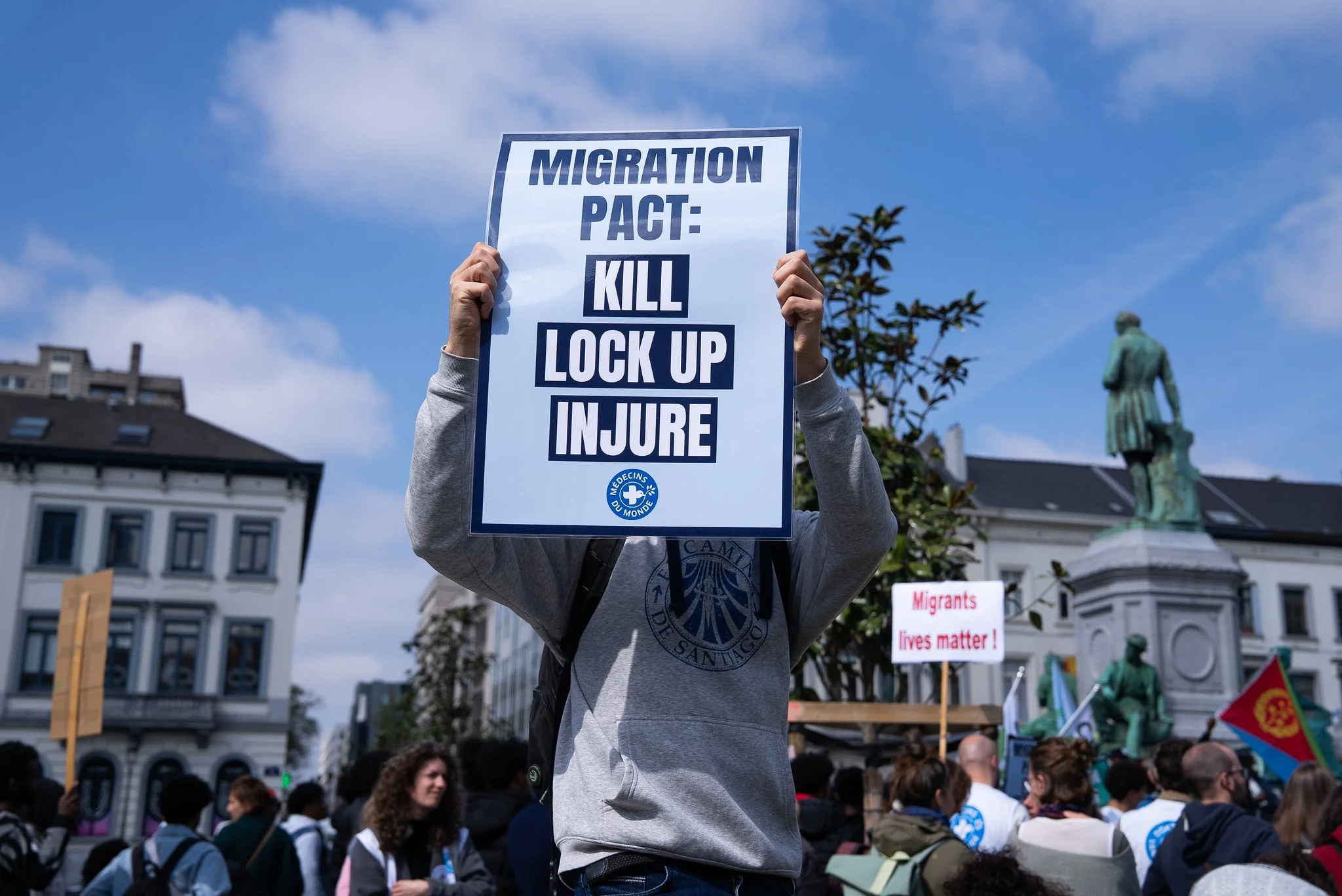
Demonstration against the EU Pact in Brussels, on 10 April 2025.
by Magdalena Rassmann, interim coordinator at BVMN. Published on 10 June 2026. Co-published with Border Violence Monitoring Network.
“A bad beginning makes a bad ending” reportedly wrote the Greek playwright Euripides in one of his lost tragedies. Yet, more than 2400 years later, EU authorities are failing to heed Euripides’ call, and are choosing sideline civil society as they prepare to rollout the long awaited New Pact on Migration and Asylum later this week.
The exclusion of civil society expertise has been a defining feature of the Pact from its earliest legislative stages through to its adoption in April 2024. Ever since the European Commission presented its proposal in September 2020, and throughout years of negotiations and trilogues, the Pact's reform package has been widely criticised by NGOs, human rights organisations, legal scholars, and international bodies. Critics repeatedly warned that the reforms would undermine access to asylum in Europe while expanding detention, facilitating pushbacks, enabling racial profiling, and deepening the externalisation of migration control beyond EU's borders. Their warnings were largely ignored. The Pact was adopted anyway.
Alarmingly, the sidelining of civil society did not end there. Rather, it has been reproduced throughout the two-year implementation phase, during which Member States were tasked with translating the new European framework into national legislation.
Greece and Bulgaria provide particularly stark examples. Situated at the EU's external borders, both countries will play a central role in implementing some of the Pact's most troubling provisions. The Screening Regulation introduces extensive deprivation of liberty through screening procedures accompanied by limited procedural safeguards, reinforced by the legal fiction of non-entry. At the same time, expanded concepts of safe third countries and inadmissibility risk denying access to asylum procedures and exposing people to chain deportations and refoulement.
Both states took almost the entire two-year implementation period to publish draft legislation. Yet when the drafts finally appeared, meaningful engagement with civil society remained notably absent.
In Greece, the draft implementation law was published less than a month before the Pact's provisions were due to enter into force. Civil society organisations were given only two weeks to provide comments and recommendations. This suggests that this consultation process is merely symbolic, not substantive.
The content of the draft law itself reflects the migration policies pursued by the Greek government in recent years, opting for some of the most restrictive measures available under the new EU framework. Among other provisions, it expands the grounds for detention and detention-like conditions, shortens procedural deadlines in asylum cases, weakens vulnerability assessments, and further restricts access for lawyers and civil society organisations.
Bulgaria follows the same logic by different means. Although the draft appeared earlier, it was created with zero participation from civil society and contains no vision for meaningful collaboration with civil society on implementation. Further, it offers no provisions guaranteeing NGO access to the new screening facilities or border procedures - the precise spaces where independent monitoring is most necessary and most likely to be denied.
The problem extends beyond Greece and Bulgaria: In a context of shrinking civic space and the increasing disenfranchisement of people on the move, a broader pattern emerges: civil society participation may be formally acknowledged, but it is rarely taken seriously. At best, organisations are consulted with little influence. At worst, they are silenced, harassed, or criminalised. The expertise they provide, the border violence they document, and the warnings they raise seldom appear to substantively affect political outcomes.
This matters because, in a European migration system increasingly defined by detention, deportation, and externalisation, independent scrutiny becomes more important. As vast resources are channelled into surveillance technologies, border infrastructure, and migration control, transparency and accountability are simultaneously diminished. Civil society organisations remain among the few actors capable of documenting abuses and identifying protection gaps, and holding authorities accountable to the standards they are obliged to uphold. Their exclusion weakens oversight precisely when it is needed most.
If the exclusion of civil society was a defining feature of the Pact's beginnings, its continuation raises a troubling question: what kind of ending is the European Union prepared to accept?