
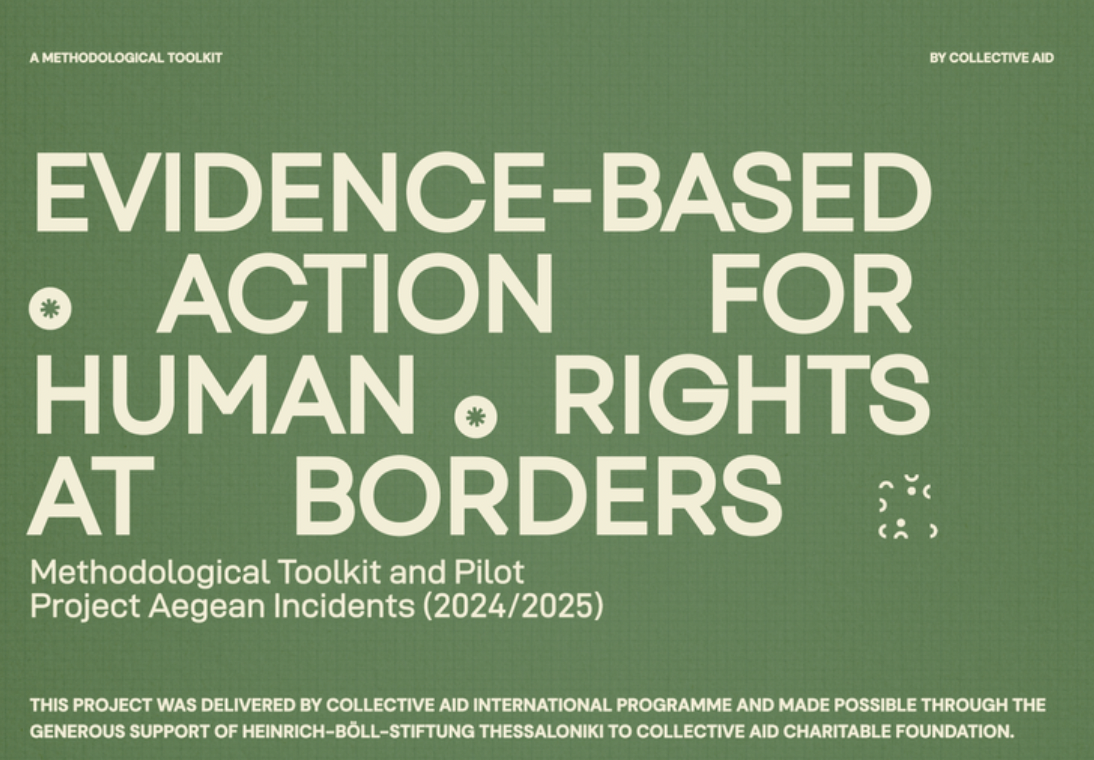
Webinar Evidence-Based Action for Human Rights at Borders Project - Methodological Toolkit and Pilot Project Aegean Incidents 2024/2025
The Webinar
The Collective Aid International Team has recently concluded the project Evidence-Based Action for Human Rights at Borders Project - Methodological Toolkit and Pilot Project Aegean Incidents 2024/2025.
To mark the close of the project, we hosted a webinar presenting the core methodological insights behind the toolkit - a framework developed to standardize the monitoring of border violence incidents in the Aegean Sea. The pilot phase covered data from 2024–2025, documenting pushbacks, shipwrecks, apprehensions, and rescues.
At the heart of the project is a transparent and replicable methodology for collecting, coding, and verifying incident-level data drawn from often conflicting sources, including Greek and Turkish Coast Guard communications, media reporting, and NGO documentation. The toolkit establishes clear definitions and verification tiers, enabling researchers and practitioners to assess the reliability and consistency of reported incidents.
Importantly, the toolkit was designed with transferability in mind. While piloted in the Aegean context, its modular structure, including core definitions (such as “pushback” and “rescue”) and adaptable verification levels, allows it to be applied to other border regions, whether land borders, desert routes, or emerging EU external frontiers. The aim is not only documentation, but methodological harmonization across contexts.
You can re-watch the webinar here and download the slides here.
Key Findings from the Pilot Data
The pilot dataset documents more than 3,600 incidents across the two-year period, 2,554 in 2024 and 1,062 in 2025, affecting at least 82,239 people.
Among these:
54% of the people who tried to cross the Aegean Sea were prevented from seeking asylum
263 deaths and disappearances were documented, many of them as result of violent practises by the Greek Coast Guard
The Hellenic Coast Guard (HCG) was linked to 595 pushback incidents, affecting 17,105 people.
59% of HCG-reported incidents involved criminalization practices.
100 shipwrecks were recorded, 48 of which involved fatalities — often in contexts connected to enforcement operations.
The findings highlight patterns of violent enforcement, gaps in official reporting, and the urgent need for multi-source verification systems to ensure accountability and accuracy. By triangulating data across institutions and independent monitors, the toolkit demonstrates how methodological rigor can strengthen human rights documentation in highly politicized border environments.
The findings will also be published in the in a data analysis briefing coming out soon.
Looking Ahead
The toolkit was conceived as a collaborative instrument. If you believe it could be useful in your own context, we would be glad to continue the conversation and explore potential adaptation or partnership. Strengthening evidence-based advocacy depends on shared standards, open exchange, and collective commitment.
Please do not hesitate to reach out on advocacy@collectiveaidngo.org