
Voices from Iran: Conversations from the field in January
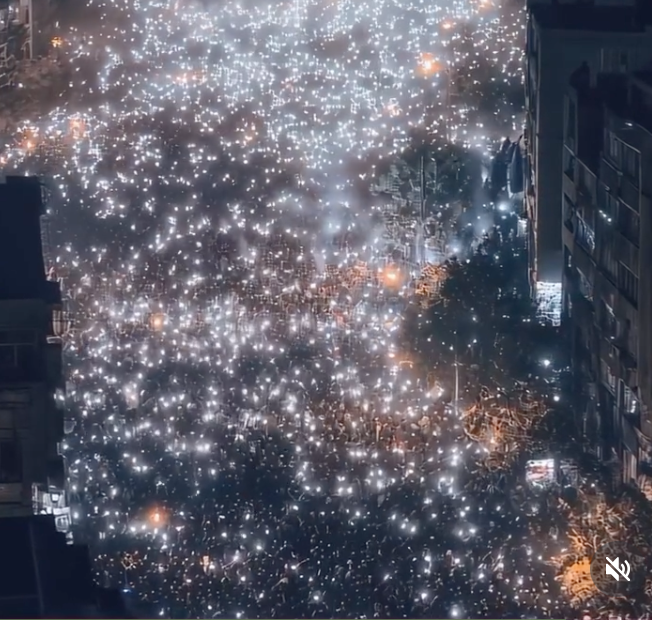
People protesting on the streets of Tehran, January 2026
Introduction
In January 2026, as Iran descended into what would become one of the deadliest government crackdowns in modern history, a few Iranian men we have met during our distributions in Bosnia shared their stories. These conversations are direct experiences of people who have seen the consequences of the regime of the Islamic Republic. By sharing their stories, we aim to show up in solidarity for the people of Iran, and all the others who experience oppression by governments.
The timing of these conversations is significant. As these men spoke, Iran had just imposed a near-total internet blackout on January 8, cutting off communications as protests intensified across the country. By late January, reports suggested that between 30,000 and 36,500 people may have been killed, in just the first two days following the blackout, though the true death toll remains difficult to verify. Many of the men whom we have spoken to had families they couldn't contact, trapped in a country where the European Union had just designated the Islamic Revolutionary Guard Corps (IRGC) as a terrorist organization in response to the brutal crackdown.
These are their stories, told in their own words.
A Handball Coach Imprisoned:
The most detailed account came from an Iranian handball coach who worked within the IRGC complex, a position that would ultimately seal his fate when he witnessed atrocities in his work place, in 2009.
The Beginning: A Coach in the Army
“These stories I want to tell are a short part of my life in Iran and the events that happened to me,” he began. “I had a normal life in Iran and had no problems with the regime or anyone else, [...] but at some point I realized that it is truly a great betrayal of myself and my other friends. [...] Because I was once part of this complex, the IRGC. And because I knew what I was supposed to do, it was very difficult for me, so I decided to start talking.”
He worked as a handball coach in the army, a position that gave him access to facilities where some of Iran's darkest secrets were hidden. What he witnessed around that time would haunt him for years.
2009: Witnessing the Green Movement Massacres
“In 2009, when people in Iran protested in the streets due to the elections, unfortunately, people were unaware of the crimes that had taken place in the same place where I was working as a coach. Most of the deaths that happened were in the same place where I worked, and I knew where they were, but unfortunately we didn't have the right to speak out.”
He began talking with a colleague about what he had seen or heard. He explained that he was “completely unaware of the fact that all our conversations, whether on the phone or in person, were being monitored by the regime, and they were listening to our conversations and spying on us.”
The consequences came swiftly. “One day they called me in and told me I had no right to work here anymore. Because there, my friend and I talked a lot about the regime and the rights that were being taken away from people. Unfortunately, they had heard everything we said with their listening devices. [...] [They] considered this an action against the regime and we were accused of treason against the system.”
The warning was chilling: “We should never hear about this again and that you will always be under control.”
Ten Years in Hiding
What followed was a decade of paranoia and survival. “After I was discharged from the army, unfortunately I couldn't get a phone because it was being tapped, and I lived in secret for 10 years. [...] I mean, I couldn't find a government job, I had to do illegal work, and no one had my name or even my number because they couldn't find me. [...] Unfortunately, it was very difficult. I couldn't contact them [his family] because I knew they were also being monitored.”
The Arrest: False Drug Charges.
“One day I was standing on the side of the street, wanting to go and see a friend of mine, talk to her, and borrow some money because I was in really bad shape. For a moment, I don't know what happened to me. I think there were about 20 people who came at me and started beating me. No matter what I asked them, what are you beating for, what did I do, and who are you? No one answered, they just kept beating.”
The brutality was public and theatrical. “A lot of people gathered around where I was, filming and taking pictures. Believe me, they wouldn't treat a murderer like this. Anyone who has killed even one person doesn't deserve this. They beat me so much that I was unconscious and couldn't even walk. Two people grabbed me by the hand and dragged me down the street and put me in a car.”
Inside the vehicle, the torture continued. “They started beating me with a handgun. They were hitting me from behind. He kept telling me to 'confess, confess'. I said, 'what should I confess to? What do you want from me?'. Maybe they just beat me for an hour in the car, telling me to confess, but they didn't say what I should confess to. I kept asking, they just beat me.”
The psychological impact was profound. “Believe me, I've been living with him [mentally] for several years now and I can't forget him at all. It's very hard to forget him.”
The Frame-Up
The purpose of the beating soon became clear. “After beating me for a while, they took out a bag of crystal meth and told me it was yours. I swore to them, I swore to God, that this bag is not mine. Where did it come from? Why do you want to accuse me of having a package of drugs with me? No matter how much I begged them, no one listened to me.”
He was taken to an unknown location, blindfolded, and held for 48 hours. “They kept me in one place for 48 hours. After 48 hours, several masked people came and beat me again for maybe two or three hours to get a confession from me and for me to admit that I had drugs.”
Qezel Hesar Prison: Six Months of Limbo
“After those 48 hours in that place whose name I don't know, they transferred me to Qezel Hesar prison. It was only when I got there that I realized what was happening to me, and since they had no excuse to arrest me and do anything to me, they accused me of drug dealing. I take God as my witness that I have never touched drugs, and I have never made any money from them, and I had nothing to do with drugs in Iran”
Qezel Hesar Prison, located near Karaj, is one of the largest and most notorious prisons in Iran. Established in 1964, it has become infamous for severe overcrowding, catastrophic sanitary conditions, and widespread human rights violations. The prison was sanctioned by the U.S. Department of State in December 2024 due to torture and inhumane treatment.
"It was only when I entered there that I realized how pathetic and despicable the regime was, what harm it was doing to the people and youth of that country, and I realized this in prison."
He spent six months in limbo, with no clarity about his case. “I was in Qezel-e-Hassar prison for 6 months, in limbo. I had no idea what my case was, why I was there, and why. After 6 months of being indecisive and not knowing why I was there, they took me to the Revolutionary court. They had blindfolded me, tied me up, and handcuffed me.”
The Trial: A System That Acknowledges Innocence But Cannot Act
What happened at the investigator's office revealed the cruel machinery of the Islamic Republic's justice system.
“The investigator who was interrogating me realized that they were lying and apologized to me saying, 'Forgive me, I can't do anything for you. I have to send your case to the judge'. I begged him, 'You know I'm not into this, you know I'm not around these things at all. For God's sake, tell me the truth.' He said, 'I can't'.”
As he left, the men who had framed him were waiting. “Those three main people were there with that commander, smiling at me and saying, 'Have a good time in prison'.”
The investigator completed the case and sent it to the Tehran Revolutionary Court for drug trafficking and drug dealing charges. On the way to court, he asked a soldier handling his case about his arrest.
“She read my case and my verdict and said, 'These are the IRGC security forces, the IRGC security battalion'. I asked what the IRGC's security had to do with drugs. He said, 'I was left wondering why they accused you of this'. He said that when someone does something against the Islamic Republic and they don't have an excuse, they will imprison them for drug crimes and maybe even execute them.”
The soldier's next words confirmed the systemic nature of his persecution. “She told me, [...] ‘we all know that you are innocent, even my investigator knows it, but we cannot give an order against the decision of the Revolutionary Guards. The case must go to court.”
The Sentence: Ten Years
After two more months, he appeared before the judge for sentencing. “Unfortunately, the hired lawyer they gave me didn't believe me, and the judge told me I had to accept my fate. The judge sentenced me to 10 years in prison.”
He was transferred to prison without visitation rights or phone calls. “I was so hurt there, I was tortured there, it's very, very difficult for me to say. Let me just give you one example: they stripped me naked in front of everyone and whipped me. What logic does this have? What humanity should I believe in?”
The despair was overwhelming. “A few times I even wanted to be injected with drugs in my sleep, but my friends realized and stopped me.”
Searching for safety in Europe
When asked about his treatment in Europe after experiencing pushbacks and violence along the borders, he's response was telling:
“Even if the behaviour here is bad, or if there are no facilities, at least I know that I don't belong here.”
He continued: “Thank you for your support and I am truly grateful that I feel so good every time I come here [our distribution in Sarajevo].”
His final declaration was unequivocal: “I made up my mind that I want to fight against that regime until the day I die.”
Earlier, when asked about activism, he had explained: "Unfortunately, I had a lot of problems in Iran and the regime kept me in prison for several months, 17 months without any visits. I wanted to be [an activist], but unfortunately the regime was very strict and we were forced to hide all the time, fearing for our lives, so that no one would see us."
When asked if he was hopeful things might change, he said: “I hope so. I'll do my best. I love my countrymen in a way. I want my country to be free from that terrorist regime.”
The Internet Blackout: Families in Darkness
On January 16, 2026, another Iranian man spoke about the immediate crisis unfolding at home. His account captures the anguish of being cut off from loved ones during one of the deadliest government crackdowns in Iranian history/
Our volunteer recounts another conversation with a different Iranian man: “Today I talked with an Iranian man. He told me that he hasn't been hearing from his family for days. Iran cut internet connections. He said that they (government) cut it during the protests. They don't want foreigners to come or people to go out so no one can know what happens in Iran.”
On January 8, 2026, Iranian authorities imposed a near-total internet and telecommunications blackout, as nationwide protests intensified. The shutdown, which affected mobile phone towers, SMS, and phone calls, was designed to hide the scale of human rights violations being committed by security forces.
“They have a huge power and wealth and they use it just to hurt people. ‘Let everyone know what oppression we have in Iran'”
His message carried a poignant contradiction, while praising the Iranian people's hospitality, “if you would manage to come to Iran, normal people would take care of you, they host you and help you, you would spend so little money”, he acknowledged the terror of the state.
By the time of this conversation, credible reports suggested that security forces were carrying out large-scale killings across the country. Human Rights Watch reported, that Iranian civil society organizations estimated the death toll had reached the thousands, though the ongoing internet shutdown severely hampered efforts to verify the scale of unlawful killings.
The Firefighter: Service, Injury, and Disillusionment
On January 19, another volunteer spoke with a former firefighter whose story illustrated both the pride of public service and the deep disillusionment with the regime.
“A man from Iran told me he had a good job in Iran, working as a firefighter. He's been doing it for many years and is very proud of his work. He told me it's very rewarding to save people's and children's lives from accidents and fires.”
The work had taken its toll. “He told me that because of his work, he broke his leg twice, damaged his spine, and had trouble breathing because of the toxic fumes. But breathing is better now.”
Despite his dedication, the compensation was inadequate. “He had four positions in his department but was only paid for one. The pay wasn't good.”
The Crisis and the Call for the Shah
“He told me there are many problems in Iran. He said that a few days ago the regime cut off the internet and that they're killing many people. He needs to know how his family is doing, but he can't. Plus, he can't receive money from them this way.”
The conversation turned to recent political developments that suggested shifting international attitudes. “He told me that some governments are putting the Revolutionary Guard and the Iranian government on their terrorist lists.”
Indeed, on January 29, 2026, the European Union added Iran's Islamic Revolutionary Guard Corps to its terrorist list, in direct response to Tehran's deadly crackdown on protesters.
“Another Iranian man joined the conversation. Both told me they would be happier if the Shah returned.”
This reference to the Shah, Reza Pahlavi, who was overthrown in the 1979 Iranian Revolution, represented a striking reversal of historical sentiment. The men offered a controversial interpretation of that revolution's origins.
“They told me that the '79 revolution was supported by some foreign states that didn't appreciate the fact that the Shah was raising oil prices. They believe the Shah wasn't a bloodthirsty man, at least.”
The 1979 revolution that overthrew Shah he Reza Pahlavi ended Iran's 2,500-year-old monarchy and established the Islamic Republic under Ayatollah Khomeini. The Shah had ruled since 1941, using oil wealth to modernize the country through reforms known as the “White Revolution,” but also establishing the brutal SAVAK secret police to maintain control. By the late 1970s, growing numbers of Iranians turned against him, finding leadership in Ayatollah Khomeini, who returned from exile to assume power in February 1979.
Nearly five decades later, these men viewed that transition with regret.
The Intellectual Elite Under Siege
“Both say that Iranian prisons are now full of university professors, doctors, nurses, and elite figures. In Iran, studying and graduating is much more common than in surrounding countries, but the regime is such a dictatorship.”
This observation aligned with broader patterns of the 2026 crackdown, where authorities conducted mass arbitrary arrests of protesters and perceived dissidents, including many educated professionals who represented the country's intellectual class.
Hopes and dreams for the future
All of these men have left in the search of safety and a better life, however they were met with hostility, violence and deterrence on their way to the European Union.
“I spoke with an Iranian man. He told me, listening to the others around us, that many people have high expectations of Europe. He told me he wasn't looking for anything in particular. He left for an opportunity, but he could have stayed.” - our volunteer recounts.
The Iranian man further reflected: “No place is perfect, not even Europe. In many countries, people want to emigrate from their own country. Even Americans think of emigrating from America to go to space or Mars. Human dreams and desires never end. The more beautiful things you achieve, the more you think of better things. Race, language, and country of origin don't matter to a person, because we ourselves haven't made any effort to do so. How I die and where I live are what matter.”
This meditation on perpetual human longing - the idea that satisfaction is always just beyond reach - offered a counterpoint to the other narratives. While he spoke of fighting the regime until death, and the firefighter mourned his inability to contact family, this man seemed to have made peace with uncertainty itself.
January 2026: The Context of Massacre
These conversations took place during one of the darkest periods in modern Iranian history. The protests that erupted in late December 2025, began with shopkeepers objecting to the declining rial currency and rising living costs, but rapidly transformed into a broader antigovernment uprising.
The government's response was catastrophic. On January 3, Supreme Leader Ayatollah Khamenei ordered that protesters - whom he labeled "rioters"- must be "put in their place,"a direct command to the IRGC to use lethal force.
Security forces, including the IRGC and police, unlawfully used rifles, shotguns loaded with metal pellets, water cannons, tear gas, and beatings against largely peaceful demonstrators. There were reports of raids on hospitals in apparent attempts to arrest injured protesters and confiscate bodies of those killed.
The January 8 internet blackout marked a turning point. On that date alone, at least 217 people were killed in Tehran. Over the following two days, estimates suggested between 2,000 and 6,000 protesters may have been killed, with some reports of hospital death registrations suggesting the number could be far higher.
By late January, Time, The Guardian, and Iran International reported that between 30,000 and 36,500 protesters may have been killed during January 8-9 alone, based on a specific list of deaths registered in civilian hospitals. As of February 1, 2026, the US-based Human Rights Activists News Agency (HRANA) had documented 6,842 confirmed deaths, with thousands of additional cases under review.
The scale of the killing led to the use of the term "massacre" to describe what occurred. The Iranian government claimed that both protesters and security forces had been killed by "terrorists," a label that experts noted was designed to justify lethal force and reduce the risk of defections among security forces.
Iranian authorities carried out executions on a scale unseen since the late 1980s, conducted mass arbitrary arrests, and threatened medical staff to prevent information about protest-related injuries from leaking.
Bearing Witness
The closing words of the former Iranian handball coach captures the essential purpose of documenting these conversations:
“Unfortunately, the only regret I have in my heart is that I was unable to obtain any significant evidence that I could actually present to you, but I take God as my witness that everything I said is true and truthful.”
In the absence of the official documentation, case files that would endanger anyone who sought them, these oral testimonies become the evidence. They document not only individual suffering but systemic patterns: the use of fabricated drug charges to imprison political dissidents, the public torture designed to humiliate and terrorize, the knowledge of wrongdoing that extends even to investigators and soldiers who feel powerless to intervene.
The firefighter who broke his body saving lives but earned inadequate wages. The man who cannot contact his family as thousands are killed in darkness. The coach who witnessed massacres and paid for his knowledge with 17 months of imprisonment and torture.
These are the voices from Iran in January 2026, men who survived, who fled, who carry their stories across borders in the hope that someone will listen, document, and remember what happened in the country they loved enough to leave.
As he said: “I made up my mind that I want to fight against that regime until the day I die.”
In sharing these stories, we join that fight.
Accompanying words by Sarajevo Field Team and Anna Gruber