
“A River Full of Corpses”: Winter Deaths and Disappearances in Bosnia-Herzegovina and Beyond
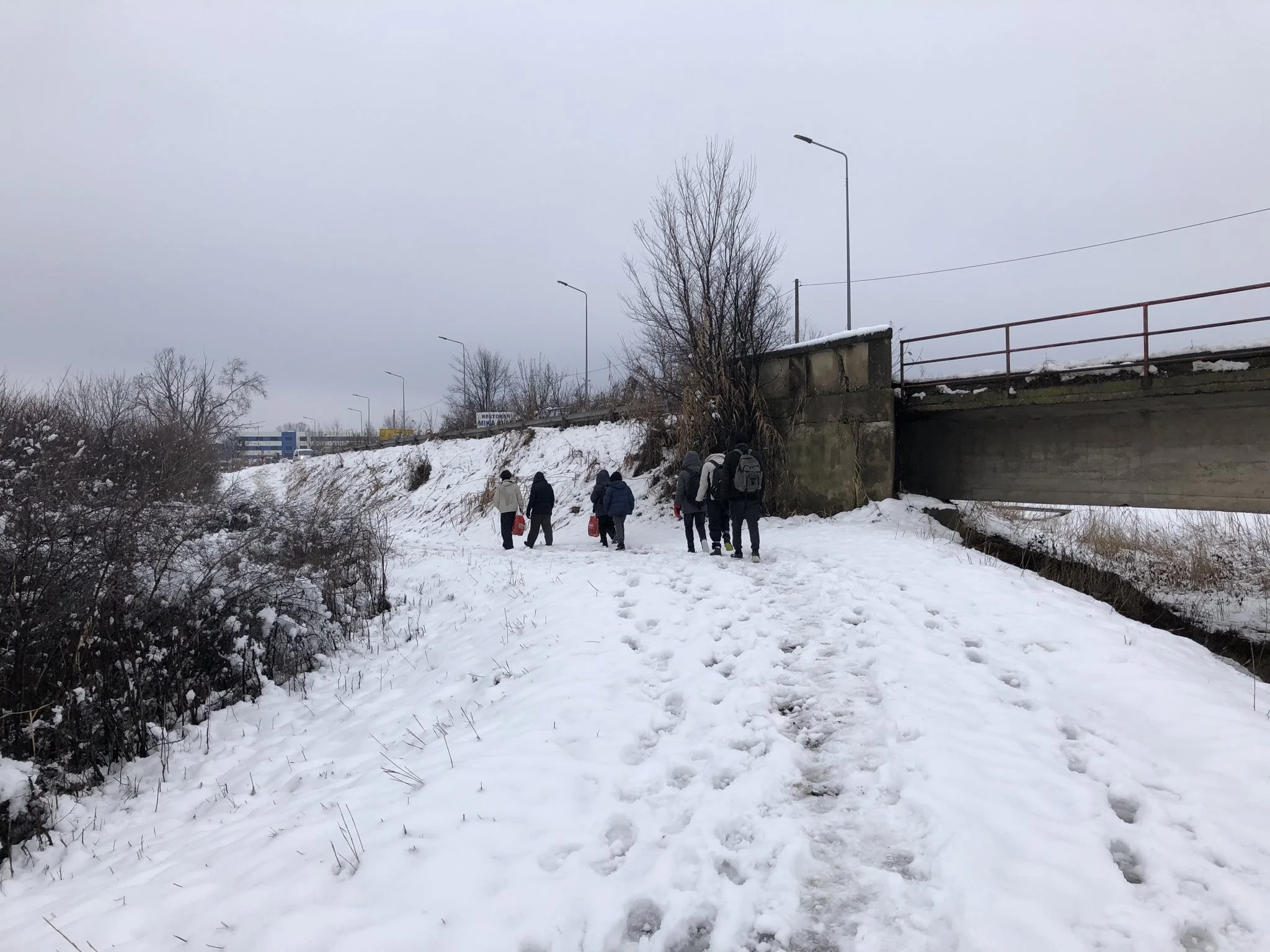
Photo taken by Collective Aid
With the winter return to Bosnia and Herzegovina and Croatia, our field team in Sarajevo is deeply alarmed by the growing number of reports regarding deaths of people on the move in Bosnia & Herzegovina and beyond.
As rivers freeze and temperatures drop, people seeking safety in the European Union continue to die. This is not only down to the lack of coordinated rescue operations, but for lack of political will and state-fostered violence on borders.
Rivers Turned into Borders of Death
On 17 November 2025, the Kolpa River, separating Croatia and Slovenia, claimed the life of a young man attempting to swim across as his brother and cousin watched helplessly from the river bank. Ten days later, on 27 November, two others disappeared into the Drina River between Bosnia and Serbia, with their fate likely still unknown.
Then, during the early hours of 11 December, a boat carrying 13 people overturned while crossing the Sava River near Slavonski Brod. Thick fog and winter cold made the crossing deadly. When rescuers arrived, they described screams emerging from the darkness. Three people, two women and a man, lost their lives that morning. Authorities later reported that the victims were mostly from China and Turkey, and that ten survivors were hospitalized for hypothermia. Another traveler remains missing, their identity known only through the travel document found at the scene.
Nothing can reduce the weight of suffering that each and every death brings, but we face a harsh reality where death on the Balkan route is no surprise. And what compounds this pain is the silence that typically follows. With the exception of large-scale tragedies such as this one - or when 11 people drowned in the Drina river due to their boat also overturning in 2024 - reporting on these incidents is usually extremely limited at best, and political will for change feels non-existent. Families are left without answers, and change and accountability never comes.
Missing, Forgotten, Unnamed
Beyond what reaches the public eye, humanitarian groups have reported many unconfirmed deaths and disappearances this winter. On the same night as the Sava river tragedy, an Algerian man reportedly went missing while trying to cross Croatia’s Mrežnica River. His friend, still searching weeks later, shared his photo with our field team in the hope that someone, somewhere, might recognize him, alive or dead.
In August and September 2025, unidentified men were found to have drowned along the Drina River, one believed to be Egyptian, the other never even identified by nationality. “The Drina is a river full of corpses,” a man in Blažuj camp once told our team. His words, chilling and matter-of-fact, reflect a grim truth: across Bosnia’s borders, death has become a hidden reality.
The scale of this tragedy extends far beyond what appears in winter headlines. According to a report published by Klikactiv in June 2025, forty-four people died between 2020 and early 2025 while attempting to cross the Drina River on the eastern border with Serbia alone. People recovered from the river are often unrecognizable, making identification extraordinarily difficult. When families learn of a death - if they are informed at all - they face insurmountable obstacles: the costs of DNA testing, the impossibility of traveling to a foreign country without resources or visas, the absence of official channels for communication. Where communication occurs, it is only through the fragile networks of activists and volunteers, not through state apparatus designed for this purpose.
Thus, the silence usually surrounding these deaths deepens the suffering of families scattered across continents. Many never receive confirmation or closure; their loved ones remain “missing,” known only to databases like 4D’s online archive, or buried under a headstone marked NN - “no name.” As Bosnian pathologist Vidak Simić explained in a BBC article, “Someone is looking for that body - a father, a mother, a brother. Why not give those families peace, to know where their relatives are, how they passed away?”
Systems that enable death
Despite widespread NGO reporting, official responses remain scarce. In December 2025, the death of Mukter Hossain, a Bangladeshi man who died in Lipa camp following deliberate withdrawal of emergency care by camp administration, after a violent encounter at the Bosnian-Croatian border, received almost no public acknowledgement. No investigation has been announced.
The recent Frontex investigation into the deaths of three Egyptian minors in Bulgaria, who froze to death after border police ignored repeated rescue alerts, exposes how these deaths are not an exception, but a structural pattern. The deaths were preventable, and the authorities responsible were alerted in time. Nonetheless, accountability remains elusive.
These tragedies are not products of misfortune or smuggling alone. They are the direct outcomes of political choices: policies that criminalize irregular entry, externalize asylum procedures, and rely on violence and deterrence as tools of border governance. The indifference that follows each death, each missing person, each amputated limb reflects a deliberate refusal to see.
The Cost of Fortress Europe
In Sarajevo and across Bosnia, humanitarian teams continue to encounter the people who have lost friends and relatives, being directly impacted by the violence perpetrated at Europe’s borders. Already this year, three Sudanese men lost both their legs to frostbite, while another lost his toes. Further, people were reported to be admitted to the hospital over the holidays period as they’ve suffered dangerous injuries whilst trying to continue their journey through Bosnia in the winter conditions.
As one Sudanese man told our team: “Europe is the continent of human rights, but your human rights are not for us.”
For all the talk of “secure borders” and “illegal crossings,” what remains unseen are the names, faces, and families behind these numbers. Deaths and danger at Europe’s borders are not inevitable. They are the result of a continent that has chosen deterrence over protection, invisibility over identification, and silence over accountability.
A Call for Change
European migration policies must change. Beyond condemning tragedy, governments must create mechanisms of rescue, transparency, and accountability, including the identification of the dead, and the establishment of safe routes. The ongoing work of local actors, from volunteers collecting femur samples for DNA analysis, to those maintaining graveyards for the unnamed, cannot replace systemic responsibility.
Until European and regional authorities act, the Western Balkan route will remain a corridor of suffering where human rights end at the water’s edge. Families will continue to search, activists will continue to exhume, and rivers will continue to carry nameless bodies downstream, silent testament to lives that Europe refused to protect.
At the heart of this crisis lies a simple truth: these deaths are not accidents; they are the predictable consequence of policy. And until these policies change, winter will keep returning, and with it, more graves waiting to be named.
Words by Sarajevo Field Team