
Two Borders, One System: Comparing Croatia-Bosnia and Hungary-Serbia Border Violence in the context of EU border regime
Taken by Collective Aid
Introduction: Parallel Architectures of Exclusion
The European Union's external borders have become laboratories for increasingly sophisticated systems of migration control, where violence operates not as an aberration but as a deliberate policy tool. Two borders are the perfect examples for this, the Croatia-Bosnia and Herzegovina and the Hungary-Serbia borders, which exemplify distinct yet converging models of border enforcement that prioritize deterrence over human rights, despite their different relationships to EU policy frameworks.
While Croatia positions itself as a compliant EU member state preparing to implement the Pact on Migration and Asylum, Hungary openly defies Brussels and its centralized migration policy, framing its border wall as a defense of European civilization. Yet beneath these divergent political narratives lies a shared reality: systematic pushbacks, routine violence, and the instrumentalization of detention as a migration management tool.
In conversations with people on the move in Serbia and Bosnia, we often hear about how both borders operate as zones of legal exception where international protection obligations are suspended and where surveillance and technology facilitates rather than prevents human rights violations.
This analysis examines how these two borders function as interconnected points in Europe's border regime, comparing their technological infrastructure, methods of violence, and political contexts while centering the voices of those who experience the effect of the border regime firsthand.
Political Context: Divergent Stances on EU Migration Governance in 2025
Croatia has embraced its role as a frontline EU state, with Interior Minister Davor Božinović affirming that Croatia “will be ready in time for the implementation of the Pact on Migration and Asylum and will fulfill all obligations arising from it”. This compliance, however, manifests not through improved protection mechanisms but through intensified border securitization, the lack of access to asylum reflecting the main focus of the EU Migration Pact.
In November 2025, Croatia proposed significant amendments to its foreigners and asylum laws, introducing mandatory language requirements, extended detention periods, and stricter controls explicitly designed to “curb secondary movements” and “prevent abuses of the asylum system”.
The Croatian government frames its border securitization as professional law enforcement, with officials praising their “professionalism and organisation” in reducing illegal crossings by 52% in 2025 through technological investment. This rhetoric masks documented systematic abuses. As policy analyst notes, Croatia “has fully embraced the EU's harsh migration agenda” while contributing to “the racialization and criminalization of movement” openly.
Contrary to Croatia, Hungary's approach is characterized by open defiance of EU migration policy. Prime Minister Viktor Orbán has declared, “I want to make it absolutely clear once and for all that as long as Hungary has a national government, we will not implement this outrageous decision”. This rejection is coupled with a daily penalty of €1 million for not complying with the Pact, imposed by the European Court of Justice, which by April 2025 had accumulated to over €500 million in total fines.
Hungary's political narrative frames the border fence, started in July 2015 and recently reinforced to 4.5 meters with steel enhancements, as protecting Europe itself. Hungarian officials argue that without Hungarian border protection, “numerous European countries would have to reinstate checks on their borders”. This rhetoric of defending Christendom and European civilization transforms border enforcement into a performative sovereignty exercise, with the government maintaining a public website displaying real-time pushback statistics despite claiming almost zero asylum applications.
While both countries hold different stances toward European migration governance, they nevertheless “successfully” contribute to its priorities and objectives by sustaining a system that prevents people from seeking protection and penalizes those who attempt to do so.
Technological Infrastructure: Surveillance as Violence Multiplier
The Croatia-Bosnia border has become a testing ground for aerial surveillance technologies that extend state power deep into Bosnian territory. Croatian police operate approximately 40 thermal imaging towers along the frontier, supplemented by mobile units and fixed-wing drones capable of scanning “several hundred square kilometres” for up to 12 hours. Once movement is detected, drones can be airborne within five minutes, with coordinates relayed to ground units that deploy police dogs to ensure “rapid and safe apprehension”.
This technological architecture enables violence that is both precise and inescapable. In our field conversations, drones do not merely detect but actively participate in pushbacks. A Palestinian man pushed back in September 2024 reported that after being beaten and robbed of his passport, phone, and €300, a drone “followed them until they were back in Bosnian territory, to ensure they did not go back to Croatia”. Another Afghan man described being caught five hours after crossing when “Croatian police returned them to the border and made them cross it,” noting that “there were a lot of cameras and that they were even followed by drones”.
The technology creates a panopticon effect where people know they are visible but cannot locate the watchers. A Syrian respondent described how, despite walking in a forest, he was spotted by cameras: “he didn't understand how as if he had been walking in a forest”. This uncertainty, whether one is seen by drone, thermal camera, or ground patrol, becomes part of the psychological architecture of deterrence.
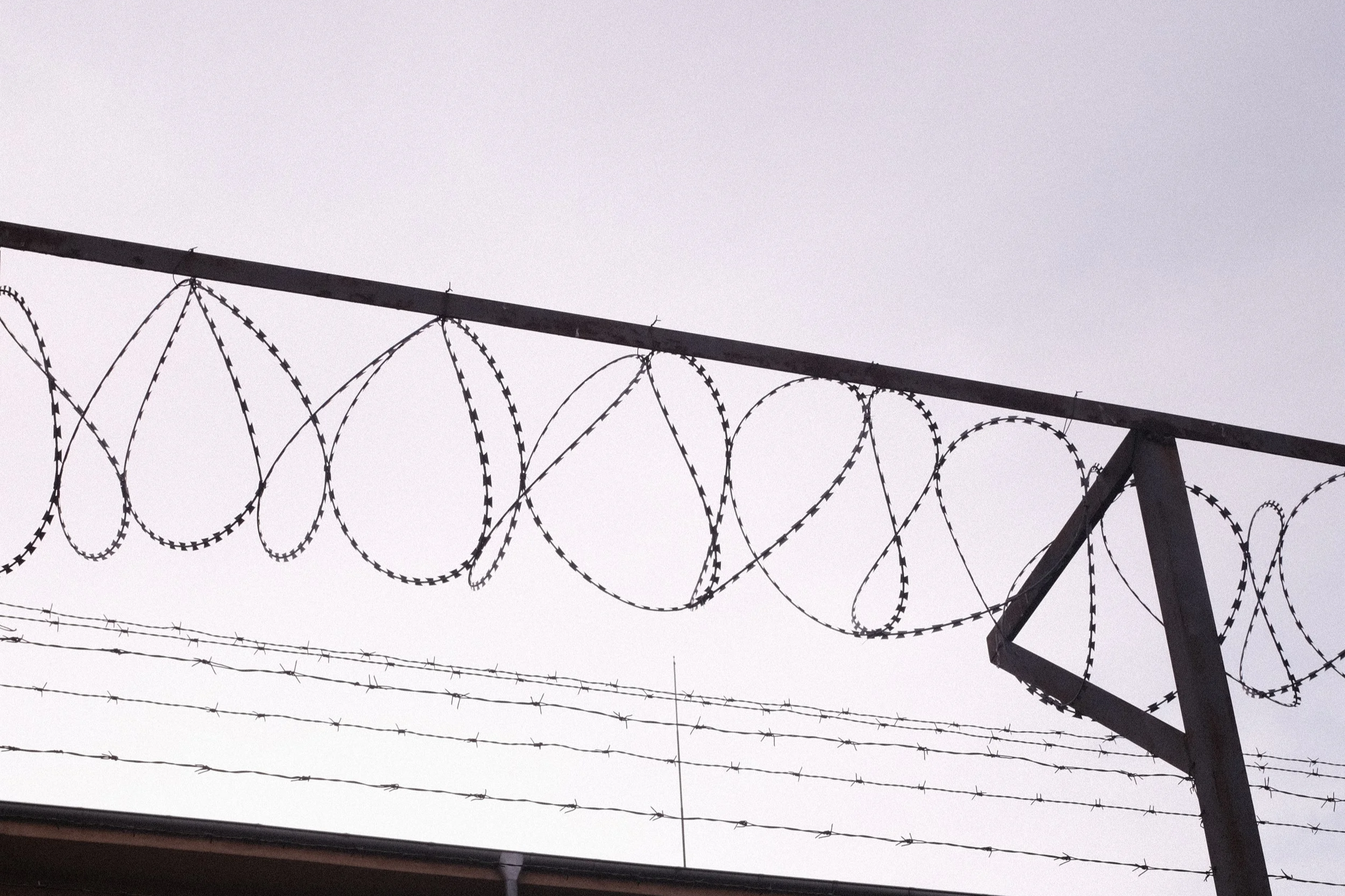
On the Hungarian-Serbian border, the technology is more openly shown as militarized. The 155-kilometer fence features 4.5-meter-high double fencing capped with barbed wire, monitored by “thousands of surveillance cameras” and fiber optic cables that alert officers to any interference.
The fence itself functions as a weapon. In June 2024, two minors aged 10 and 13 required hospitalization after attempting to climb it as discovered in our field conversations. A man whom our team has recently met showed us an injury in his finger, manifesting the physical consequence of the fence. Unlike Croatia's hidden and mobile surveillance, Hungary's system is static and punitive. The fence creates a clear binary: those who breach it face immediate violence and summary return. As conversation echoed, “the cameras were very visible” near Horgoš, but this visibility does not prevent crossing attempts; rather, it ensures that those who try are immediately detected and targeted.
Methods of Violence: Systematic Abuse as Policy
Pushbacks from Croatia follow a ritualized pattern designed to dehumanize and deter. Continuously, on the field we hear from people how the Croatian authorities frequently steal or destroy phones, money, identity documents, and other personal property, and often subject children and adults to humiliating and degrading treatment, sometimes in ways that are explicitly racist. This is not random theft but systematic erasure of legal identity and financial resources.
Violence is both physical and psychological. People report being lined up for group beatings with sticks and boots. One man showed “two big gashes on his head and a small cut on his arm,” insinuating they came from stabbing, while his friend suffered dog attacks. Police engage in cruel psychological games: “they told them to sit, and when they sat they asked 'why are you sitting down?' so they stood up but then were asked 'why are you standing?' and then they were beaten again”.
The destruction of belongings serves a strategic purpose. Multiple conversations reveal police burning bags and jackets in front of their owners, breaking phones, and ripping documents. One man reported that the police “bought food with their money and then brought it back to the station saying this is your money, you paid for this”. This performative humiliation adds to the psychological violence and power the police exercises.
River crossings have also become instruments of violence on the Bosnian-Croatian border. A Palestinian man was “forced to wade chest deep through two freezing rivers, holding his bag above his head” while police held guns and counted down from 10, threatening to shoot if he didn't comply.
Contrary to the Croatian-Bosnian border, the Hungary-Serbia border operates through a detention-centered model and intensive collaboration between Hungarian and Serbian border forces. An Afghan man apprehended near Horgoš described being beaten immediately upon discovery by 15 police officers using batons “all over their bodies including their faces”. He was then driven 30 minutes to a prison where he spent eight days in conditions he described as “a small room and very dirty, a real person would not stay there”
Detention serves multiple functions: punishment, and deterrence. The respondent had his fingerprints and photograph taken, was forced to sign untranslated documents, and denied access to a Persian interpreter despite requesting one. When he complained of a broken wrist, the doctor “took photos but did not do anything” and provided no treatment.
This pattern repeats across conversations. People report detention on both sides of the border. A minor held for two days near the Serbian border described being denied food and water despite having money to purchase them, while sharing a room with a family whose young children received only beans. On the Hungarian side, people are detained “up to three days without food and water, before being driven back to Serbia”. One group of minors reported being called “taleban! taleban!” during detention, with an Afghan man stating, “I don't deserve this, I'm not a criminal”.
The cooperation between Hungarian and Serbian police, repeatedly mentioned in conversations, transforms the border into a space where violence is shared by Serbian and Hungarian border forces. People apprehended in Hungary are “handed over” to Serbian police, who then detain them in facilities, before transferring them to reception centers.
Recently, there have been also reports of the Hungarian and Serbian police actively exchanging information about people on the move such as fingerprints.
The Scale of Violence
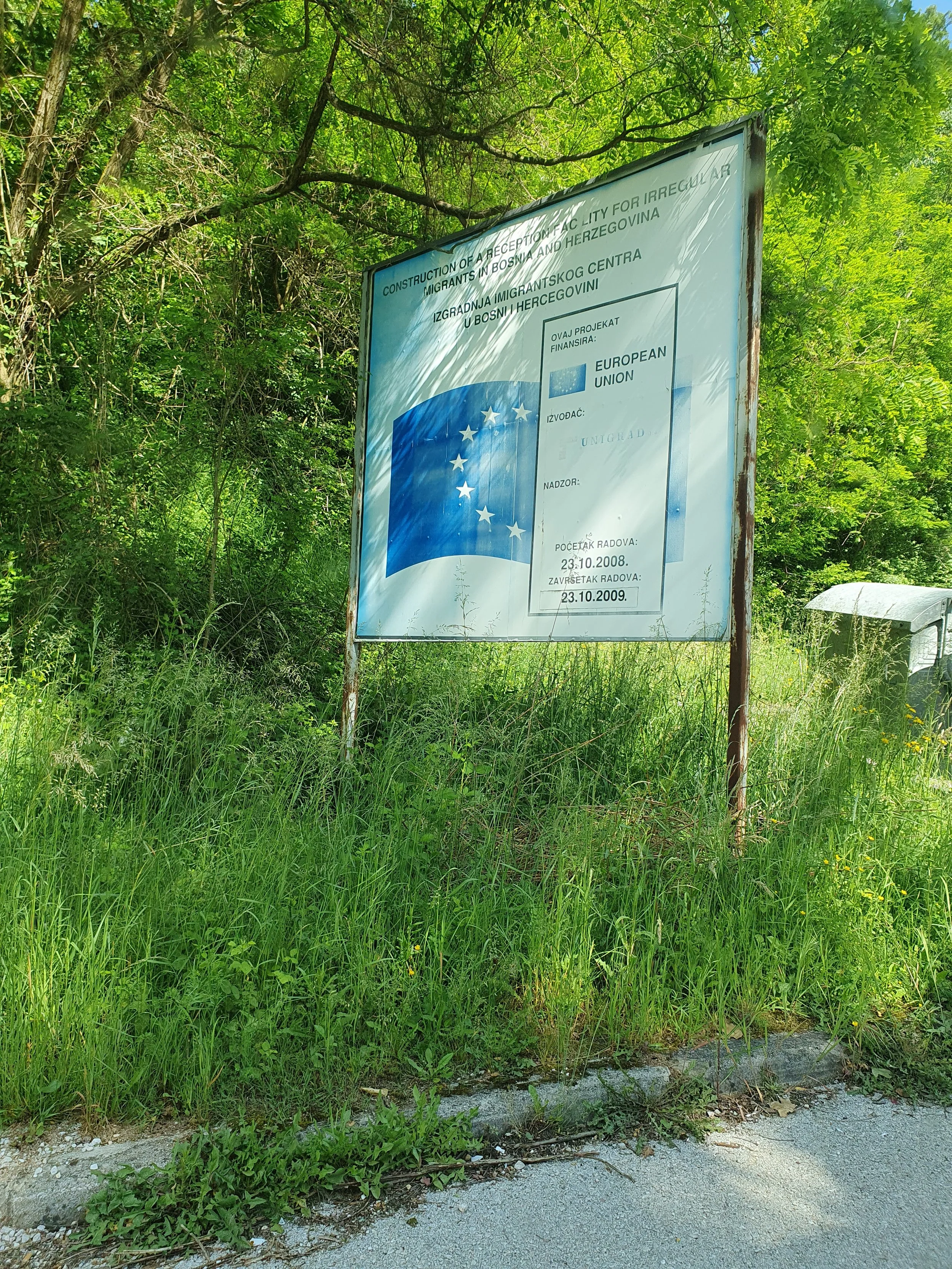
Croatia conducts mass pushbacks and expulsion that Human Rights Watch describes as now common. Between January 2020 and December 2022, nearly 30,000 pushbacks from Croatia to Bosnia and Herzegovina were recorded, while in 2023 alone, 3,323 pushbacks, with 825 persons denied access to asylum procedures were documented. This is a pattern that since these numbers, our team continuously sees. Almost every single conversation mentions a pushback or violence on the Bosnian-Croatian border.
On the Hungarian-Serbian border, there have been over 255,000 official pushbacks recorded by Hungarian police on the border with Serbia. Collective Aid has been operating in Serbia for over ten years, and this particular border has been continuously referenced throughout its work due to the persistent and systematic nature of these pushbacks.
Taken by Collective Aid
Frontex and International Complicity
Frontex operations in Serbia complicate accountability. The agency began operations on Serbia's northern borders in 2022, but officers often wear no identifiable insignia, making it very difficult to determine the involvement of Frontex in these unlawful operations. However, conversations frequently mention “foreign officers” at the Serbian-Hungarian border, who speak a different language, indicating Frontex's contribution to the violence happening along the border.
What is clear is that Frontex presence correlates with increased violence. Reports indicate that when Frontex became present on the Serbian territory, we started seeing more pushbacks from the south, but also we started noticing more police violence on the north borders. The EU's investment in Serbian border surveillance, framed as capacity-building, effectively outsources violence to non-EU territory where legal accountability is more tenuous.
Croatia's cooperation with Bosnia follows a similar pattern of externalization. Mass deportations involve many people handed to Bosnian authorities, with Croatian police burning belongings to destroy evidence.
What people highlight from their experience on these borders
In this section, we reveal how people describe these borders to paint an accurate picture to the extent of violence and the most important patterns people highlight. In April 2025, a conversation with an Afghan man revealed the complete absence of due process about the Serbia-Hungarian border. He tried crossing near Horgoš and was spotted by visible cameras and tower surveillance. Fifteen police officers beat his group with batons before imprisoning them for eight days. The systematic nature of the abuse is evident: no interpreter was provided, medical treatment for a broken wrist was denied, and the cell conditions were deliberately degrading. The respondent's question - “why he and the three other men had trouble in Serbia if they were trying to run away from there” - exposes the logical absurdity of pushback policies that punish escape attempts from Serbia while preventing entry to Hungary.
In May 2025 another conversation documented Serbian police violence against three men near Loznica. After being stopped by eight officers in identifiable Serbian police vehicles, they were held in a van for six hours without food or water, then driven 50 minutes to Šabac prison for 20 days. The 18-20-year-old respondent was slapped for not standing quickly enough, while another was repeatedly fed pork despite religious objections. This incident illustrates how detention in Serbia functions as a parallel system of punishment.
On the Bosnian-Croatian border, the patterns of violence are slightly different described by people. In September 2024 a conversation demonstrated the drone-assisted pushback system. A Palestinian man had his documents, phone, and €300 stolen before being beaten with batons. Police forced him through “two freezing rivers” while a drone monitored his return, ensuring he didn't attempt to re-cross. The auditory landscape of violence is also present: “when they were in the forest in Croatia, before they were found by police, they could hear the shouts and cries of other people who were being beaten by the police not far away”
Another conversation from July 2024 reveals discriminatory violence patterns on this border. A Turkish man reported that Croatian police told him he wouldn't be beaten “because he is Turkish,” explicitly stating they “specifically beat people from Afghanistan, Pakistan, etc.” This racialized violence is systematic, not arbitrary.
Another conversation with a Syrian man shows the evolution of tactics. When crossing by boat, Croatian police fired guns in the air and followed him into Bosnian territory. He also described cameras in forested areas, confirming that surveillance penetrates even remote crossing points. His decision to lie about being Egyptian “if you tell them you're Syrian, it's much worse treatment. He said you're dead” - reveals how nationality-based discrimination is common knowledge among people on the move.

Taken by Collective Aid
Comparative Analysis: Two Models, One Outcome
While the Croatia-Bosnia and Hungary-Serbia borders operate within different technological, legal, and political frameworks, they ultimately converge on the same outcome: the normalization of systematic violence as a routine method of migration management. In both contexts, border enforcement is not an exceptional response to movement but an entrenched system in which harm, deterrence, and exclusion are structurally embedded.
At the level of enforcement technology, Croatia relies on mobile patrols and aerial surveillance that extend policing deep into Bosnian territory, effectively producing a fluid and shifting border zone without fixed physical barriers. Hungary, by contrast, has constructed a static fence that creates a hard territorial divide, channeling people into increasingly dangerous crossing attempts. Despite these differences, both regimes deploy thermal imaging and camera systems to detect and intercept movement. In Croatia, drones facilitate cross-border pursuit, while in Hungary the fence itself functions as an instrument of violence, causing injuries and enabling forceful apprehension. In both cases, technology serves less to manage borders than to intensify control and reduce accountability.
Violence at both borders follows consistent and recognizable patterns. Croatian police practices are marked by ritualized degradation, including the confiscation or destruction of personal belongings, forced river crossings, and psychological intimidation. Hungarian violence is more overtly carceral, concentrated during apprehension and within detention facilities, where beatings and prolonged confinement are widely reported. Although these practices differ in form, they rely on the same logic of deterrence through harm. Racialized targeting underpins enforcement in both contexts: Croatian police frequently discriminate explicitly on the basis of nationality, while Hungarian violence tends to be more indiscriminate at the moment of capture, reproducing racialized control through mass apprehension.
Both border regimes also rely on the externalization of responsibility through cross-border practices that undermine access to asylum. Croatia largely operates unilaterally, carrying out mass expulsions to Bosnia with more minimal bilateral coordination. Hungary, in contrast, maintains active police cooperation with Serbia, producing a circular system in which individuals are repeatedly transferred between jurisdictions. Despite these procedural differences, both approaches displace accountability beyond EU borders, either by pushing people into a non-EU state or by relying on bilateral arrangements that effectively circumvent EU oversight mechanisms.
Politically, both governments frame these practices as legitimate and necessary, albeit through different narratives. Croatia cloaks its violence in the language of EU compliance and professional border management, presenting pushbacks as aligned with European standards. Hungary, meanwhile, openly embraces confrontation, using the fence as a symbol of sovereignty and civilizational defense.
Conclusion: The Normalization of Border Violence
The Croatia-Bosnia and Hungary-Serbia borders demonstrate that EU migration policy has created a race to the bottom where violence is not a bug but a feature. Whether framed as compliance or defiance, both models achieve the same outcome: transforming Europe's borders into zones where international law is suspended and human rights are negotiable.
The systematic nature of this violence is perhaps its most disturbing characteristic. As field data reveals, pushbacks are so normal and systematic, the same thing happens everyday. People report being pushed back up to ten times, each time experiencing beatings, theft, and degradation. This is not the result of rogue officers or isolated incidents, it is policy implemented through technology, bilateral agreements, and legal frameworks designed to evade accountability.
For those caught in this system, the borders represent not a line to cross but a zone of perpetual punishment. As one Afghan man stated after his detention and beating: “I don't deserve this, I'm not a criminal” Yet under current EU policy, seeking asylum has been criminalized, and the borders have become sites where this criminalization is enforced through systematic violence.
The comparison between these two borders reveals that the question is not whether EU member states comply with migration policy, but how they weaponize their position, whether through technological sophistication or defiant fortification, to create a border regime that makes asylum inaccessible by design. Until accountability mechanisms are strengthened and the fundamental right to seek protection is prioritized over deterrence, these parallel systems of violence will continue to operate with impunity, staining Europe's claim to be a continent of human rights and rule of law.
Research by Sofie Rosenblad (Advocacy Officer) and Anna Gruber (Advocacy Manager)
Words by Anna Gruber